
How to Toilet Train a Dog: A Realistic Week-by-Week Guide
Here is the short answer before the details. How to toilet train a dog comes down to two things done relentlessly: get your dog outside before it needs to go, and reward it the instant it goes in the right spot. Everything else is scheduling. Most puppies become broadly reliable indoors between four and six months of age, and an adult dog relearning the habit often gets there faster, because it already has bladder control. Owners who struggle are rarely doing the wrong thing; they are doing the right thing inconsistently. Below is a realistic week-by-week plan, what to do when progress stalls, and the point at which structured dog training in Queensland is worth considering.
How toilet training actually works
Toilet training is not a lesson your dog learns once. It is a habit built out of hundreds of repetitions, and it runs on two mechanisms. The first is prevention. A dog that never gets the chance to toilet indoors never builds the habit of doing so, which is why the schedule matters more than anything you say in the moment. You are not waiting for your dog to need to go and then reacting; you are taking it out so often that the need arrives while you are already on the grass.
The second is reinforcement. When your dog toilets outside and something good happens immediately afterwards, that spot starts to feel like the normal place to go. The reward has to land while your dog is still in the act or within a second or two of finishing outside; a treat delivered at the back door rewards coming inside, not what happened on the lawn. Puppies also have a physical limit you cannot train away, because bladder and bowel control develops gradually over the first few months, so planning around that limit is what separates a smooth first fortnight from a miserable one.
The setup that makes week one easier
Pick one toilet area and use only that, reached by the same door every time, because scent does much of the teaching for you. Keep small soft treats by that door, since a reward eaten in a second keeps your timing tight. Decide who is doing which outings, because toilet training falls apart fastest where everybody assumes somebody else has taken the dog out. Have an enzymatic cleaner ready too, as ordinary cleaners leave scent markers your dog still detects, which quietly invites a repeat in the same corner.
Week by week: a realistic timeline
Week one: build the schedule
This week is pure prevention. Take your dog out first thing, last thing at night, after every meal, nap and play session, and roughly every hour or two in between while it is awake. Go out with your dog rather than sending it alone, because you cannot reward what you did not see. Stand quietly, let it sniff, and the moment it goes, mark it with a cheerful word and hand over the treat on the spot. Expect accidents this week; they are data, not failure.
Week two: start reading the signals
By now you should be learning your dog’s tells: circling, sudden sniffing at the floor, drifting towards a door, a brief restlessness mid-play. Respond immediately rather than finishing what you were doing. You can also begin stretching the gaps between outings by fifteen or twenty minutes at a time, while keeping every post-meal and post-nap trip intact.
Weeks three and four: fewer trips, more freedom
Most dogs are getting it by now, which is exactly when owners relax too far, and the accidents come back. Widen the gaps gradually, give your dog one extra room at a time rather than the whole house, and keep rewarding outdoor toileting generously, because the behaviour is still fragile.
Weeks five to eight: making it reliable
Here you are proofing the habit rather than teaching it. Practise in new places and at different times of day, because a dog that only ever goes on your back lawn can be stumped by a paved courtyard. Taper the treats slowly so praise carries the load.
Why routine and consistency do most of the work
A dog’s toilet habits are built on the predictability of its day. Meals at the same times produce bowel movements at predictable times, and a settled rhythm of sleep, play and outings makes the whole thing legible to your dog, which is what it needs to get it right.
A change of household is therefore where many owners lose ground. A week with a well-meaning neighbour who lets the dog out whenever they remember can undo a fortnight of careful work, because the pattern the dog relied on has gone. A properly structured dog boarding stay with a set daily rhythm keeps meals, rest and toilet breaks on the clock while you are away, so your dog comes home still inside the habit. If you are using a sitter instead, write the schedule down and ask them to follow it to the letter.
Accidents, setbacks and the long day problem
When an accident happens, clean it up without comment. Telling your dog off after the event does not teach it where to go. What it reliably teaches is that toileting in front of you is risky, so some dogs start sneaking off behind the couch, which is far harder to unpick. Note the time, work out which outing you missed, and tighten that part of the schedule. A plateau usually traces back to gaps that got long too quickly, unsupervised access to too much of the house, or rewards arriving indoors.
The hardest case is the long working day. A dog left for longer than it can physically hold on has no option but to go inside, and no amount of training changes that arithmetic. It is worth reading our guide to how long you can leave a dog alone alongside this one, because the answer sets the ceiling on how fast toilet training can move. If a previously reliable dog suddenly starts having accidents, or is straining or drinking far more than usual, a vet should assess it rather than you treating it as a training problem.
When hands-on help is worth it
Most dogs do not need professional input to learn where to toilet. Some do, and it is not a failure to recognise yours is one of them. The honest markers are a dog well past six months with no pattern forming, a rehomed dog whose previous life taught it something different, a dog that toilets only on concrete, or a dog whose accidents sit alongside obvious anxiety, which usually means the anxiety needs addressing first.
In those situations, the value of an experienced trainer is not a secret technique. It is the ability to watch your particular dog, spot the gap in the routine you can no longer see, and get the whole household applying the same rule. If you would rather have an in-person assessment than keep guessing, dog training on the Fraser Coast is a local to start, and your list of accident times is the most useful thing to bring.
Frequently asked questions
What is the best age to start potty training?
Start the day your puppy arrives, which for most is around eight weeks. At that age, you are building the routine rather than expecting reliability, since bladder control is still developing. An older or rehomed dog can start immediately, using the same method.
When can puppies go outside to pee?
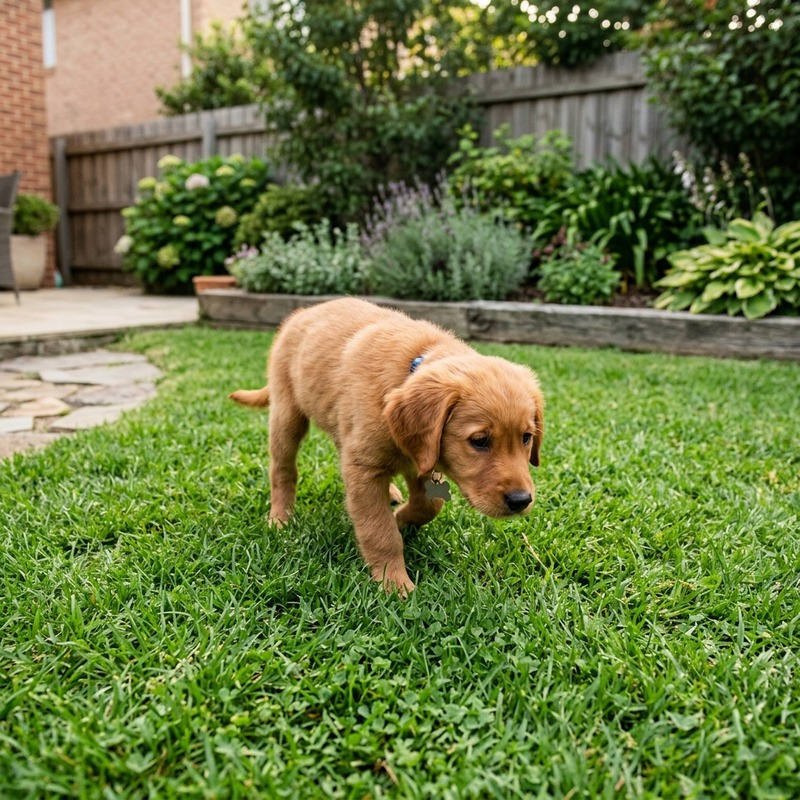
Your own backyard is usually fine from the start if it is secure and not used by unknown dogs. Public parks are a different question while vaccinations are in progress, so ask your vet what is sensible for your puppy’s stage.
Can you train your dog to use a human toilet?
It has been done, but it is a party trick rather than a practical plan. It relies on your dog managing an awkward surface and a flush it may find frightening, and it does nothing for the skill your dog actually needs: going outside on cue wherever you are.
How do you get a puppy to poop?
Use timing rather than persuasion. Take your puppy out five to fifteen minutes after a meal, straight after a nap, and after active play, since all three get things moving. Let it sniff and potter without interruption, then reward the moment it finishes. If a puppy seems uncomfortable, speak to your vet.
Give it a few weeks of real consistency
Toilet training rewards patience far more than cleverness. Keep the outings frequent, reward outside and on the spot, clean up accidents without a word, and hold the routine steady even when it feels tedious. If you would like a hand with your own dog, the team at The Mutts Nuts is glad to talk it through, so get in touch with us whenever suits you.