


How Long Can You Leave a Dog Alone?
There is no single number, and anyone who gives you a flat answer in hours is guessing. The honest answer depends on your dog’s age, health, toilet needs, the temperature, and what your dog actually does with the time alone. As a general guide, many healthy adult dogs can manage a standard working day’s absence reasonably well, but treat that as guidance rather than a rule, because it suits some dogs and not others. The one thing worth saying plainly is that a dog left regularly for longer than it can cope with does not simply adapt and get used to it. This article gives you a practical way to judge your own dog, rather than a number off a chart.
What actually sets the limit for your dog
The right limit is set by the dog in front of you, not by a figure on a website, and several things shape it:
- Toilet needs. How long your dog can comfortably hold on is often the first practical limit. A dog that needs to go and cannot is both uncomfortable and distressed, and expecting it to wait too long is unfair.
- Age. Older dogs may need more frequent toilet breaks and can find long stretches harder going, so an ageing dog often manages less than it once did.
- Health. A dog with a health condition, or one on medication, may need closer attention and shorter absences. What suits a fit, well dog does not suit an unwell one.
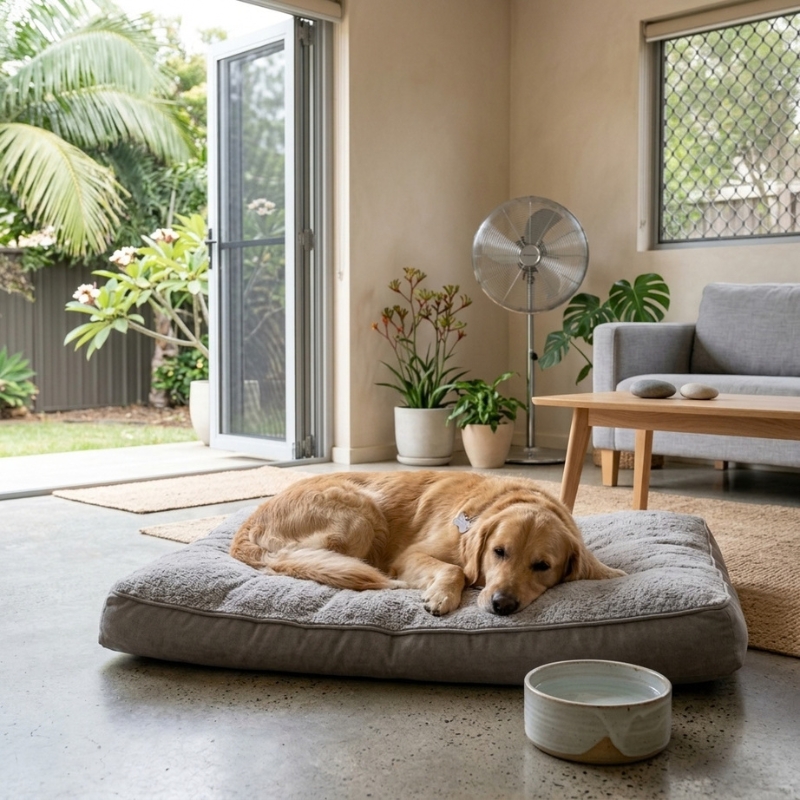
- Water access. A dog left alone needs reliable access to fresh water the whole time, and that matters more the longer the absence and the warmer the day.
- Temperature. Heat changes everything, and in a Queensland climate a stretch that is fine on a mild day is not fine on a hot one. A comfortable, well-ventilated spot is essential.
- Whether the dog settles or paces. Some dogs sleep contentedly for most of the day, while others pace, pant, bark or work themselves up. A dog that settles copes with far more time than one that does not.
Put those together and you can see why the number varies so much from one dog to the next. Two dogs of the same breed in the same street can have very different limits, because the limit is about the individual dog, its routine and its day, not a one-size-fits-all rule.
How to tell whether your dog is coping
The good news is you do not have to guess, because a coping dog and a struggling one leave observable evidence. A few things to look at:
What the dog does in the first twenty minutes. The settling-in period tells you a lot. A dog that pads about, has a drink and curls up is managing. A dog that paces, whines or scratches at the door well past your leaving is finding it hard.
Whether food left out is eaten. A dog that is relaxed enough to eat during the day is generally coping. One that leaves food untouched until you are home may be too anxious to settle.
Whether bedding is disturbed. A bed that has been dug at, dragged around or left askew can be a sign of a restless, unsettled day rather than a peaceful one.
Whether neighbours report barking or howling. Your dog is quiet when you are home, so you may never hear the barking that happens when you are not. A quiet word with a neighbour is one of the most useful checks you can do.
The state the dog is in on your return. A dog that greets you, stretches and carries on is different from one that is frantic, panting or clearly wound up the moment you walk in.
The simplest honest test is to prop your phone up to record the first half hour after you leave. Watching it back shows you exactly what your dog does once the door closes, which is the one thing you can never otherwise see, and it often settles the question one way or the other.
Never the car, and why Queensland makes it worse
One place a dog should never be left alone, even briefly, is a parked car. A car sitting in the sun heats up far beyond the temperature outside, turning into an oven even when the day feels only warm. The common fixes people reach for do not work: parking in the shade does not stop it heating up, and leaving a window cracked makes little meaningful difference. The car still becomes dangerously hot, and it happens faster than most people expect.
In a Queensland summer, the margin is very small indeed, because the starting temperature is already high, so there is almost no safe window at all. “Just ducking in for a minute” is exactly how dogs come to harm, because a quick errand turns into a longer one, and the inside of the car climbs the whole time.
It is also worth knowing that leaving a dog in a hot car can be an offence in Queensland. Rather than me set out the legal detail, the current position is best checked with RSPCA Queensland, whose guidance covers what the law says and what to do if you see a dog shut in a hot car. The simple rule for your own dog is the safest one: if you cannot take the dog with you out of the car, leave the dog at home.
What to do when the day is longer than your dog can manage
When your day runs longer than your dog can comfortably handle, the answer is not to leave it and hope; it is to arrange something. The options escalate with the length of your absence:
- A midday break. For a day that runs a bit long, a midday walk, or a neighbour, friend or family member popping in to let the dog out, toilet it and give it some company, can bridge the gap nicely. It breaks up the day and resets the toilet clock.
- A daytime arrangement. If long days are a regular thing rather than a one-off, a standing daytime arrangement where your dog spends the working day somewhere it has company and space takes the pressure off entirely, so you are not watching the clock every day.
- A proper stay for a trip away. When you are away overnight or for several days, a day-to-day fix no longer covers it, and the honest option is a proper stay somewhere your dog is cared for the whole time. For a trip, farm dog boarding in Queensland means your dog has room, routine and company while you are gone, rather than long stretches alone at home with someone briefly checking in.
None of these is a failing on your part. Recognising that your dog needs more than your day allows, and arranging for it, is exactly what a responsible owner does.
Judging it for your own dog
The limit on how long your dog can be left alone belongs to that particular dog, shaped by its age, health, toilet needs, the temperature and how it fills the time, not to any number you will read online. And you do not have to guess at it, because the evidence is observable: watch the first half hour, check whether food is eaten and the bed left settled, ask a neighbour, and read the state your dog is in when you get home. When the day runs longer than your dog can manage, arrange something rather than stretch it. If you would like to know how we look after dogs while their owners are away, have a look at our farm dog boarding in Queensland.