
How Do You Stop a Dog From Pulling on the Lead?
You know the feeling: your dog throws itself against the lead, your shoulder takes the strain, and a walk that should be the best part of the day becomes something you quietly dread. Here is the whole thing in two sentences. Your dog pulls because pulling works; it drags, you follow, and it gets where it wanted to go. The moment pulling stops getting the dog anywhere is the moment it starts to disappear. This article gives you a method you can start on your very next walk, built on that one principle, along with how to set the walk up to succeed, what to do when it stalls, and how to tell ordinary pulling apart from something that needs more.
Why your dog pulls in the first place
To fix pulling, it helps to see why it happens, and it is simpler than most people think. It is a reward loop. Your dog wants to get to the next smell, the next tree, the park up ahead, so it pulls. You follow, because you are attached to the other end. The dog reaches the thing it wanted, and in that instant the pulling was rewarded. Do that on every walk and you have, without meaning to, trained your dog to pull, because from its point of view pulling is the thing that makes the world come closer.
There is a second factor working against you called the opposition reflex. When a dog feels steady pressure on its collar or harness, its instinct is to lean into that pressure rather than yield to it, the same way you would brace against someone pushing you. So the harder you haul back on a tight lead, the harder the dog naturally leans forward. This is why a tug-of-war never works: you are triggering the very reflex that makes the dog pull harder. The fix is not more force; it is removing the reward.
Set the walk up before you leave the house
A good bit of loose-lead walking is won before you step out the door. Set yourself up with this quick checklist:
- Fit the equipment correctly. Whatever you use needs to fit properly, snug enough to stay put, not so tight it rubs or so loose it slips. Equipment that is poorly fitted works against you from the start.
- Decide your reward and have it accessible. Choose something your dog genuinely values- small, soft treats it can eat quickly- and keep them somewhere you can reach instantly: a pouch or pocket on the side you want the dog to walk. Fumbling for a reward kills your timing.
- Pick a quiet route for the first few sessions. Start where there is little to distract your dog: a quiet street or a calm part of the property, not the busy park. You are teaching a new habit, and new habits need an easy classroom first.
- Accept a shorter distance. The early sessions are about teaching, not covering ground. A short, successful walk beats a long, frustrating one, so drop your expectations on distance while the dog is learning.
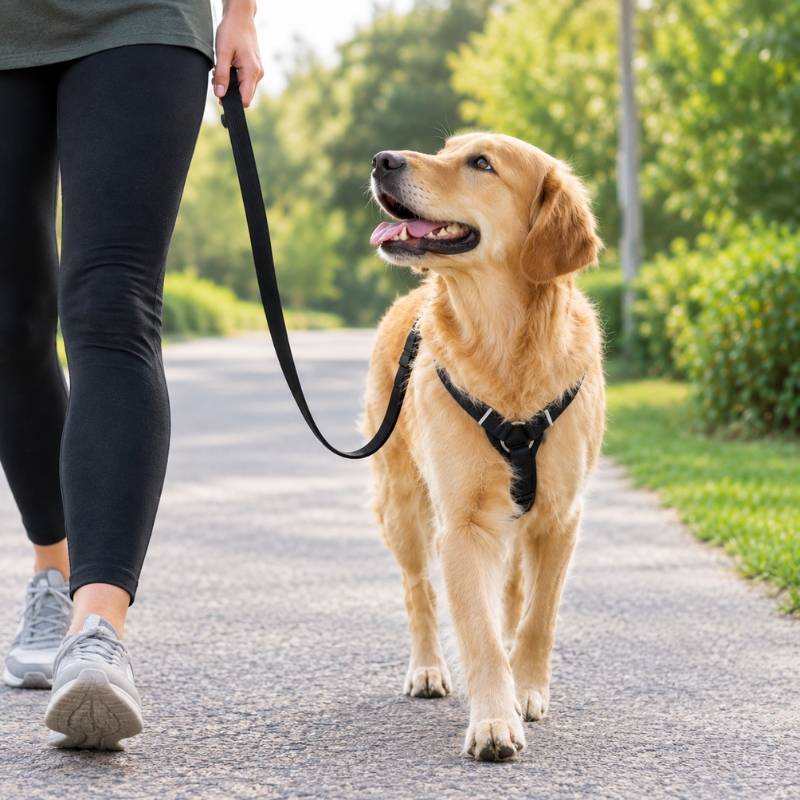
On equipment, a flat collar, a front-clip harness and a fixed-length lead all do the job, so there is no need for anything fancy. The one thing to avoid is a retractable lead, because it keeps constant light tension on the dog the whole time, which teaches exactly the opposite of what you want: that leaning into the lead is normal. A plain fixed lead lets you give real slack when the dog gets it right.
The stop-and-reset method, step by step
This is the core method, and its power is in how simple and consistent it is. You are making one thing true on every walk: a tight lead stops the walk, and a loose lead keeps it going. Here are the steps:
- Walk forward. Set off normally, with your reward ready on the side you want the dog.
- The instant the lead tightens, stop moving. The very moment you feel the lead go taut, stop dead. Do not take another step. This is the whole method in one action: pulling no longer moves you forward, so pulling no longer works.
- Wait, without pulling back. Stand still and hold your ground, but do not yank or haul the dog back towards you, which only triggers the opposition reflex. Just be a stationary anchor and wait.
- The moment the dog releases the tension or looks back at you, mark it and reward beside your leg. As soon as the dog eases off and the lead goes slack, or it turns to check in with you, say a marker word like “yes” and reward it right beside your own leg, down at your side.
- Walk on. With the lead loose again, set off once more, and repeat the whole cycle as often as it takes.
The detail that makes this work is reward placement. By feeding the treat beside your own leg, at your side, you are teaching the dog that the good stuff happens in the position you actually want it to walk in, right next to you, rather than out at the end of a taut lead. Over repetition, the dog learns that staying by your leg is where rewards come from.
The other thing that makes or breaks it is consistency across everyone who walks the dog. If you stop for a tight lead but your partner lets the dog drag them down the street, the dog learns that pulling works sometimes, which is harder to undo than if it had never been taught at all. Everyone in the household has to play by the same rule.
What to do when the method stops working
If you have been at it and progress has stalled, the method itself is almost never the problem. It is usually one of three common slip-ups, and each has a simple fix:
- Rewarding too late. If the reward comes a few seconds after the lead went slack, the dog cannot connect the treat to the loose lead and may think it is being rewarded for whatever it is doing now. The fix: mark and reward the instant the lead loosens, not a moment later.
- Stopping only sometimes. If you stop for a tight lead on some steps but let it slide on others when you are tired or in a hurry, you teach the dog that pulling pays off now and then, which is the hardest lesson of all to shift. The fix: stop every single time the lead tightens, without exception.
- Practising only in high-distraction places. If the only time you work on it is a chaotic park full of other dogs, you are asking the dog to pass its hardest test before it has done the easy ones. The fix: build the habit in quiet places first, then slowly add distraction as the dog succeeds.
Sort out whichever of these applies and the method usually gets back on track, because the mechanics underneath it are sound.
When pulling is really something else
There is one situation where stop-and-reset is the wrong tool, and it matters to recognise it. If your dog is not just keen to get ahead but is lunging, barking or fixating on other dogs, on traffic, on people, then you are not looking at a lead-manners problem at all. You are looking at reactivity, which is an emotional response rather than a learned habit, and no amount of stopping for a tight lead will resolve it on its own, because the dog is not pulling to get somewhere; it is reacting to something it finds exciting or threatening.
Reactivity needs a different approach, and it is honest to say it is hard to work through alone. What structured help actually looks like is consistent handling that everyone applies the same way, plenty of repetition in calmer settings away from the triggers that set the dog off, and a handler experienced enough to read the dog’s threshold, the point at which it tips from coping to reacting, and to work just under it rather than over it. That reading of the individual dog is the part that is difficult to self-teach. If your dog’s pulling is really reactivity, residential dog training in Queensland gives it that consistent handling and distance from everyday distractions, which is exactly the environment reactive dogs tend to make progress in.
Loose lead, one principle
Everything in this article comes back to a single idea: forward movement is the reward, so the walk stops the instant the lead tightens and continues the instant it goes slack. Set the walk up to succeed, apply the stop-and-reset method the same way every time and with every walker, and reward beside your leg so the dog learns where it ought to be. Where pulling turns out to be reactivity rather than manners, that is the point to bring in help rather than battle on alone. If you would like a hand turning your daily walk back into something you both enjoy, have a look at our residential dog training in Queensland.